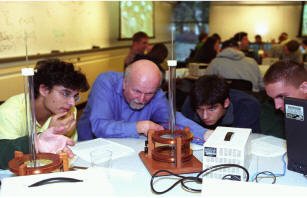
Technology-enabled active learning is a teaching format that merges lectures, simulations, and hands-on desktop experiments to create a rich collaborative learning experience. By the fall of 2005, TEAL will be used for almost all MIT introductory physics instruction. TEAL classes feature:
- Collaborative learning—students working during class in small groups with shared laptop computers
- Desktop experiments with data acquisition links to laptops
- Media-rich visualizations and simulations delivered via laptops and the Internet
- Personal response systems that stimulate interaction between students and lecturers
TEAL Software and Visualizations
iCampus provides the full set of TEAL software tools, visualizations, course lectures, problem sets, experiments, and concept questions used in MIT’s second semester introduction to physics
The iCampus TEAL site also includes the software tools used to illustrate complex electromagnetic phenomenon essential to understanding physics and the Java3D software authoring environment that is used to create the award winning visualizations of electromagnetic field behavior. In addition, the iCampus TEAL project addresses assessing the impact of educational software including assessment plans and approaches to measuring learning benefits from its use.
The pedagogical approach to teaching physics used by TEAL is based on the “studio physics” model. Course content such as lectures, and some related teaching materials for TEAL will be published in Spring 2005 on the MIT OCW site MIT TEAL 8.02 course content on OpencourseWare
What is TEAL?
Electromagnetism I, Course 8.02 at MIT, is an introduction to electromagnetic fields and forces. Electromagnetic forces quite literally dominate our everyday experience. The material object presenting this text does not fall through the floor to the center of the earth because it is floating on (and held together by) electrostatic force fields. However, we are unaware of this in a visceral way, in large part because electromagnetic forces are so enormously strong, 10 to the 40 times stronger than gravity.
Because of the strength of electromagnetic forces, any small imbalance in net electric charge gives rise to enormous forces that act to try to erase that imbalance.Thus in our everyday experience, matter is by and large electrically neutral, and our direct experience with electromagnetic phenomena is disguised by many subtleties associated with that neutrality. This is very unlike our direct experience with gravitational forces, which is straightforward and unambiguous.
The objectives of this course are to tease out the laws of electromagnetism from our everyday experience by specific examples of how electromagnetic phenomena manifest themselves. We want to be able:
- to describe, in words, the ways in which various concepts in electromagnetism come into play in particular situations;
- to represent these electromagnetic phenomena and fields mathematically in those situations;
- and to predict outcomes in other similar situations.
The overall goal is to use the scientific method to come to understand the enormous variety of electromagnetic phenomena in terms of a few relatively simple laws.
The pedagogical approach used in this course follows an active learning format, modeled in part on an approach known as “studio physics”, instituted in 1994 at Rensselaer Polytechnic Institute by Professor Jack Wilson, now directed by Professor Karen Cummings. This pedagogy has been modified and elaborated on at a number of other universities, notably in North Carolina State University’s Scale-Up program, under Professor Robert Beichner.
Why this Approach?
Even with an outstandingly effective and charismatic lecturer like Professor Walter Lewin, lecture attendance at the end of the term in MIT introductory courses hovers around 50%. No matter how strongly one feels about the intrinsic worth of the lecture format, it is hard to argue that it is broadly effective when half of the students do not attend the lecture. This lack of student engagement is arguably one of the major reasons for the failure rates (typically 15%) in these introductory courses. More importantly, this lack of engagement is the reason many students leave our introductory courses (usually their last courses in physics) feeling that physics is dry and boring. In considering the description of the TEAL/Studio course format below, keep in mind that one of the overall goals is to set up a structure that engages the students more deeply, so that they come away from these introductory courses with more of an appreciation for the beautyof physics, both conceptually and analytically.
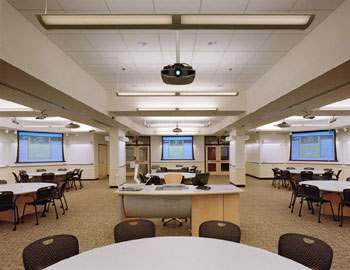
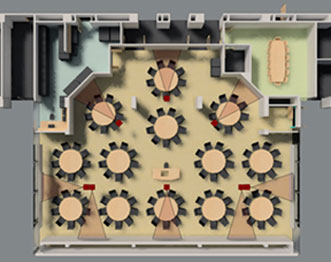
This course format differs substantially from the lecture/recitation format. In this format, classes are held three times a week, twice in a two-hour block, and once in a one-hour block. Students sit at tables of nine in a specially designed classroom (the TEAL classroom, physically located in Bldg 26-152 on the MIT campus),
 |
 |
|
TEAL classroom supporting team engagement |
TEAL classroom layout, top view |
with three groups of three students at each table. Mini-lectures are interspersed with desktop experiments and group problem solving and discussion. The one-hour session on Friday is reserved entirely for problem solving.
The course design is based on the following premises:
- interaction between teacher and student is an important factor in promoting learning;
- interaction among students is another;
- active learning is better than passive learning;
- hands-on experience with the phenomena under study is crucial.
Collaborative Work
Scientists and engineers work in groups as well as alone. Social interactions are critical to their success. Most good ideas grow out of discussions with colleagues. This subject encourages collaborative teamwork. As students study together, help their partners, ask each other questions, and critique their group homework and lab write-ups. Teach each other! Students learn a great deal by teaching others.
A major research component of the TEAL project focuses on visualization – understanding fields and their effects
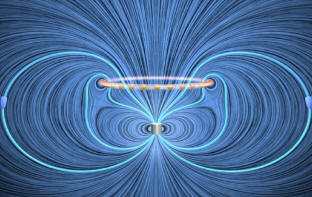
Visualization – a tool to understand electromagnetic fields and their effects
Electromagnetism is a notoriously difficult subject for beginning students. Visualization, especially animations, allows the student to gain insight into the way in which fields transmit forces, bywatching how the motions of material objects evolve in time in response to those forces. Such animations allow the student to make intuitive connections between forces transmitted by electromagnetic fields and forces transmitted by more prosaic means, e.g., by rubber bands and strings. TEAL has developed a number of simulations and visualizations along these lines, many of them suggested by the desktop experiments.
In addition to these passive visualizations, TEAL/Studio has developed Java applets that are interactive, and which illustrate many concepts in electromagnetism. This is feasible with modern laptop computers with their processing and graphics ability to, for example, calculate the motion of an electric charge in the field of a magnetic dipole, and also calculate field lines for the total magnetic field (due both to the moving charge and the dipole), using 4th order Runge-Kutta schemes. The applet then displays the field lines in a 3D rendering rapidly enough to make the motion of the charge and the field lines appear as a smooth realtime animation.